


What is Glaucoma?
Glaucoma is a group of diseases that can lead to damage to the eye's optic nerve and result in blindness.
Open-angle glaucoma, the most common form of glaucoma, affects about 3 million Americans—half of whom don't know they have it. It has no symptoms at first. But over the years it can steal your sight. With early treatment, you can often protect your eyes against serious vision loss and blindness.
What causes it?
In many people, increased pressure inside the eye causes glaucoma. In the front of the eye is a space called the anterior chamber. A clear fluid flows continuously in and out of this space and nourishes nearby tissues.
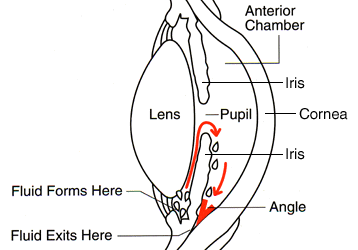 The fluid leaves the anterior chamber at the angle where the cornea and iris meet (see diagram). When the fluid reaches the angle, it flows through a spongy meshwork, like a drain, and leaves the eye.
Open-angle glaucoma gets its name because the angle that allows fluid to drain out of the anterior chamber is open. However, for unknown reasons, the fluid passes too slowly through the meshwork drain. As the fluid builds up, the pressure inside the eye rises. Unless the pressure at the front of the eye is controlled, it can damage the optic nerve and cause vision loss.
When are you most likely to have glaucoma?
Although anyone can get glaucoma, some people are at higher risk than others. They include:
- African Americans over age 40.
- Everyone over age 60.
- People with a family history of glaucoma.
 Advanced Eye Center of Texas
Tel: 936 273-0606